
Anti-Bullying Approach

Anti-Bullying at Somerdale Educate Together 


At Somerdale Educate Together Primary School, we are committed to providing a safe, inclusive and respectful environment where every child feels valued, protected and ready to learn. 

Bullying of any kind is unacceptable and will not be tolerated. We work together as a whole school community to prevent bullying, respond promptly to concerns, and support all children involved. 

Our approach is rooted in children’s rights, wellbeing, inclusion and high expectations for behaviour and relationships. 
 
Our Rights-Respecting Commitment (UNCRC) 

As a Rights Respecting School, we recognise that bullying can prevent children from accessing their rights under the UN Convention on the Rights of the Child (UNCRC), including:


  • Article 2 – the right to non-discrimination 
  • Article 12 - the right to have their voice heard
  • Article 19 - the right to protection from harm
  • Article 28 - the right to an education 

All members of the school community share responsibility for upholding these rights. 

What Is Bullying? 

At Somerdale Educate Together, we use the definition agreed by the Anti-Bullying Alliance. 

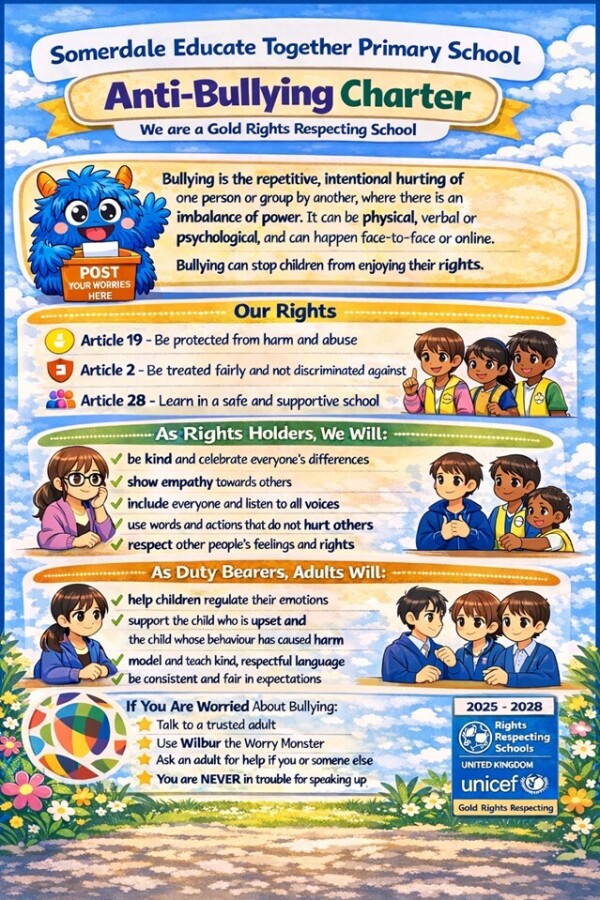
“Bullying is the repetitive, intentional hurting of one person or group by another person or group, where the relationship involves an imbalance of power. 
Bullying can be physical, verbal or psychological. 
It can happen face-to-face or online.” 
 
Key Features of Bullying 

 Bullying usually involves:

  • Intentional Behaviour - it is done on purpose
  • Repetition - it happens more than once or is likely to happen again 
  • An imbalance of power - the person being bullied finds it difficult to defend themselves

Types of Bullying 

Bullying can take many forms, including:

  • Verbal bullying - name calling, insults or threats
  • Physical bullying – hitting, pushing or damaging belongings
  • Emotional bullying – exclusion, humiliation or spreading rumours
  • Cyberbullying – messages, images or comments sent online
  • Prejudice-based bullying – linked to race, ethnicity, religion, disability, gender, gender identity, sexual orientation, family structure or social background  

All forms of bullying are taken seriously because they can interfere with children’s rights under Articles 2, 19 and 28. 
 
Bullying as a Group Behaviour 

Bullying is rarely an interaction between just two individuals. It is often influenced by group dynamics, with children taking on different roles, including:

  • Target – the person the bullying is aimed at (never to blame)
  • Ringleader – initiates or leads the bullying behaviour
  • Assistant – joins in with the bullying
  • Reinforcer – encourages the behaviour by laughing, watching or sharing
  • Outsider – is aware but does not intervene
  • Defender – challenges the behaviour, supports the target or seeks adult help 

Understanding bullying as a group behaviour helps us focus on changing behaviour and social dynamics, rather than labelling children. 


Our Anti-Bullying Charter 

Our Anti-Bullying Charter is co-created with children and reflects our rights-respecting values. 
 
What We Promise as Children 

As pupils at Somerdale Educate Together, we agree to: 

  • Be kind and celebrate everyone’s differences (Article 2)
  • Include others and make sure everyone is listened to (Article 12
  • Be empathetic when someone is upset or angry
  • Use words and actions that do not hurt others (Article 19)
  • Respect other people’s rights  

 
What We Promise as Adults 

As adults, we agree to:

  • Listen to children and take concerns seriously (Article 12)
  • Help children regulate emotions and resolve difficulties
  • Support both the child who has been hurt and the child whose behaviour needs to change 
  • Be consistent, fair and clear in expectations
  • Act to protect children’s rights at all times (Articles 2, 19 and 28)
Reporting Bullying 

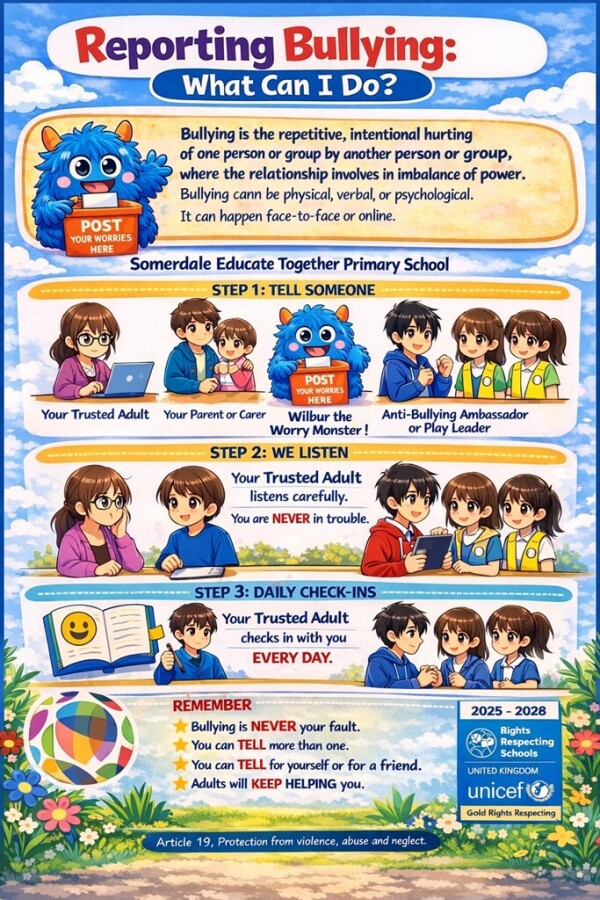
Bullying is never ignored at Somerdale Educate Together. All concerns are listened to carefully and acted upon. 
 
How Children Can Get Help 

Children are encouraged to speak up if they experience or witness bullying. This supports their rights under Articles 12 and 19


Children can:

  • Talk to any trusted adult (teacher, teaching assistant, pastoral staff or senior leader) 
  • Share concerns using Wilbur the Worry Monster, where worries can be written or drawn and checked daily by staff 
  • Talk to trained pupil leaders, who will help pass concerns on to an adult 

Children are reassured that: 

  • they are never in trouble for reporting bullying
  • bullying is not their fault 
  • adults will continue to support them until the concern is resolved

Children can speak to:

  • Their class teacher
  • A teaching assistant
  • A member of the pastoral or wellbeing team
  • A senior leader

Children are encouraged to report concerns as soon as possible, but they can do so at any time. 
 
Wilbur the Worry Monster – Pupil Voice 

Wilbur the Worry Monster provides a child-friendly way for pupils to share worries: 

  • Children can write, draw or dictate their concern
  • Worries are placed in Wilbur’s box
  • The box is checked daily by staff 
  • Any bullying concerns are followed up promptly 

This ensures all children have a safe and accessible way to be heard (Article 12). 
 
Support from Pupil Leaders 

Children can also talk to trained pupil leaders, including: 

  • Anti-Bullying Ambassadors
  • Rights Respecting Ambassadors
  • Play Leaders 

Pupil leaders listen, reassure and help children speak to a trusted adult. They do not investigate incidents themselves. 
 
Information for Parents and Carers 

Parents and carers can report concerns by: 

  • Contacting their child’s class teacher
  • Contacting the school office

Sharing concerns early helps us protect children’s rights to safety and education (Articles 19 and 28). 
How We Respond to Bullying 

Bullying is never ignored. Our response is calm, consistent, rights-respecting and safeguarding-led. 

Every reported concern is listened to carefully and followed up in line with our duty to protect children from harm (Article 19). 
 
When a Concern Is Raised 

When bullying is reported or suspected: 

  • Adults listen carefully to all accounts (Article 12)
  • Children are reassured and supported
  • Immediate safety and wellbeing are checked (Article 19)
  • Concerns are recorded in line with safeguarding procedures 

Support continues until the situation is resolved. 
 
Responding to Bullying Behaviour 

Where behaviour meets the definition of bullying, or concerns are persistent or escalating, the school will:

  • Inform parents and carers
  • Begin daily monitoring 
  • Use communication systems with families 
  • Work with all children involved to change behaviour and group dynamics
  • Use restorative approaches alongside clear expectations
  • Apply sanctions where appropriate, in line with the Behaviour Policy
  • Involve senior leaders in serious or persistent cases

These actions help ensure children can access their right to education (Article 28) safely. 
 
A Restorative and Educational Approach

Our response focuses on: 

  • Understanding the impact of behaviour
  • Repairing harm 
  • Teaching alternative, positive behaviours
  • Rebuilding relationships

Both the child who has been hurt and the child whose behaviour has caused harm are supported, in line with Articles 3 and 19
 
Monitoring and Review 

When bullying is identified:

  • Daily monitoring begins immediately
  • Communication books may be used with families 
  • Weekly review meetings take place with parents/carers and staff 

These continue until: 

  • the bullying behaviour has stopped
  • children feel safe
  • all parties agree the concern has been resolved  

Recording and Safeguarding 

All bullying concerns and actions taken are: 

  • recorded securely
  • monitored by school leaders
  • addressed immediately where safeguarding concerns arise


Anti-Bullying Ambassadors 

Somerdale Educate Together has Anti-Bullying Ambassadors from Key Stage 2 who promote kindness, inclusion and respect across the school. 
 
The Diana Award Anti-Bullying Programme 

Our Anti-Bullying Ambassadors have completed accredited training through the Diana Award Anti-Bullying Programme and are working towards the Inclusion Badge. 
Working Towards the Inclusion Badge 

Through their training, ambassadors: 

  • Develop understanding of bullying as a group behaviour
  • Promote inclusion and belonging
  • Challenge discrimination safely
  • Help ensure all pupils feel represented, valued and listened to 

This work supports Articles 2, 12 and 19
 
Clear Boundaries and Adult Support 

Anti-Bullying Ambassadors: 

  • Do not investigate incidents
  • Do not replace adult responsibility 

Their role is to listen, encourage and signpost pupils to trusted adults. 
 

Preventing Bullying 

Preventing bullying is part of everyday school life and supports children’s rights under Articles 2, 19 and 28.

We promote: 

  • Rights-respecting charters
  • Explicit teaching of kindness, empathy and inclusion 
  • Emotional literacy and self-regulation strategies
  • Clear routines and consistent expectations

Whole-School Culture and Relationships

Calm, predictable and respectful environments help children feel safe and ready to learn. Positive relationships are modelled and reinforced across the school. 
 
Wellbeing and Pastoral Support 

Pastoral support is available for: 

  • Children who feel they are being bullied
  • Children whose behaviour is causing harm
  • Pupils experiencing emotional distress linked to peer relationships


Working Together as a School Community 

Bullying prevention and response work best when children, families and staff work together. 
 
Our Shared Responsibility 

By listening, speaking up and supporting one another, we create a school where every child feels safe, valued and included, and where their rights are respected every day. 

If you have any concerns or questions, please contact the school — we are here to help